The Ecological Circumstances of the Circumstances of Politics

This is the first in a series of posts on Environmental Political Theory.


With his famous phrase “the circumstances of politics” the philosopher Jeremy Waldron offers an abstract characterization of what politics are at the most basic level. Waldron holds that Continue reading
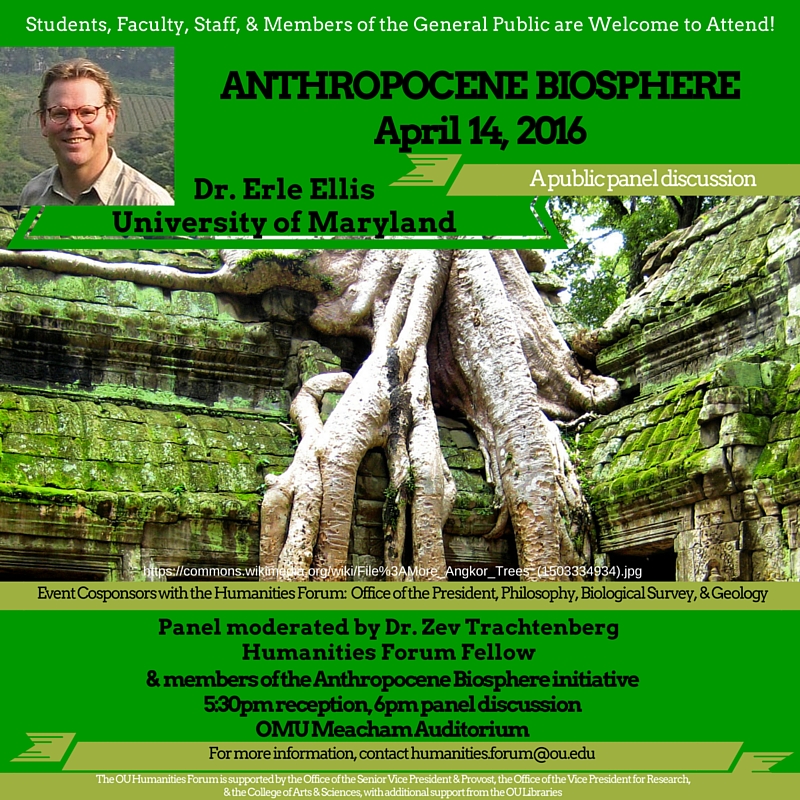
Video of Ellis Talk and Panel Discussion

THIS POST CONCLUDES OUR ANTHROPOCENE BIOSPHERE PROJECT–A SERIES ON ERLE ELLIS’ ‘ECOLOGY IN AN ANTHROPOGENIC BIOSPHERE‘ (ECOLOGICAL MONOGRAPHS, 85/3 (2015))

Continue reading

Panel Discussion with Erle Ellis

ELLIS_April14(1)On Thursday, Apr. 14 we concluded the Anthropocene Biosphere Project with a visit to OU by Erle Ellis, whose paper “Ecology in an Anthropogenic Biosphere” we have been discussing here since the end of January. Ellis met with Continue reading

The Human Climate

THIS POST IS PART OF OUR ANTHROPOCENE BIOSPHERE PROJECT–A SERIES OF POSTS ON ERLE ELLIS’ ‘ECOLOGY IN AN ANTHROPOGENIC BIOSPHERE‘ (ECOLOGICAL MONOGRAPHS, 85/3 (2015))

To understand this massive and sustained human transformation of Earth’s ecology, it is necessary to consider human societies as a global force capable of interacting with and reshaping ecology across the Earth in ways analogous to Continue reading

“From hominins to humans: how sapiens became behaviourally modern”

CITATION:
K. Sterelny. 2011. Phil. Trans. R. Soc. B, vol. 366, pp. 809–822.
ON-LINE AVAILABILITY:
ABSTRACT:
This paper contributes to a debate in the palaeoarchaeological community about the major time-lag between the origin of anatomically modern humans and the appearance of Continue reading

“The cognitive niche: Coevolution of intelligence, sociality, and language”

CITATION:
Steven Pinker. 2010. PNAS, vol. 107, suppl. 2, pp. 8993–8999.
ON-LINE AVAILABILITY:
ABSTRACT:
Although Darwin insisted that human intelligence could be fully explained by the theory of evolution, the codiscoverer of natural selection, Alfred Russel Wallace, claimed that abstract intelligence was of no use to ancestral humans and could only be explained by Continue reading

The Anthropocene Biosphere

I’m excited to announce a special project on the blog—a semester-long discussion of Erle Ellis’ 2015 paper ‘Ecology in an Anthropogenic Biosphere’ (Ecological Monographs, 85: 287–331. doi:10.1890/14-2274.1 ). In this paper Ellis proposes Continue reading

“Efforts to monitor and characterize the recent increasing seismicity in central Oklahoma”

CITATION:
D. E. McNamara et al. 2015. The Leading Edge, June 2015, pp. 628-639.
ON-LINE AVAILABILITY:
ABSTRACT:
The sharp increase in seismicity over a broad region of central Oklahoma has raised concerns regarding the source of the activity and its potential hazard to local communities and energy-industry infrastructure. Efforts to Continue reading

Environmental Under-determinism, Part 2

In my post last week I voiced the concern that rejecting the dualist separation between nature and society might lead to an implausible environmental determinism. To put it reductively, if nature and society are not two separate things, but only one thing with two separate names, it seems as if Continue reading

Environmental Under-determinism, Part 1

A few weeks ago I mentioned my interest in what I think of as “environmental under-determinism;” in this post I’ll explore the idea a bit further. It is an attempt to frame a broad understanding of the relationship between human societies and their environmental settings. In this post I will suggest a motivation for this understanding: Continue reading

“Climate change in the Fertile Crescent and implications of the recent Syrian drought”

CITATION:
Colin P. Kelly et al. 2015. PNAS, Vol. 112, No. 11, pp. 3241-326.
ON-LINE AVAILABILITY:
ABSTRACT:
Before the Syrian uprising that began in 2011, the greater Fertile Crescent experienced the most severe drought in the instrumental record. For Syria, a country marked by poor governance and unsustainable agricultural and environmental policies, the drought had a catalytic effect, contributing to Continue reading

Habitation in the Anthropocene, 2.0

HabAnth screen shot

Last week I submitted version 2.0 of Habitation in the Anthropocene: An Interdisciplinary Interaction contribution to  the Social Media in the Anthropocene project. Please click the screenshot of the homepage to visit. Continue reading

Adam Smith on the Anthropocene

I’m on a bit of a quest to find passages in writers from the past who seem to anticipate the Anthropocene idea. And in following up on my sense that Smith is aware of the phenomenon of niche construction I came upon the following, Continue reading

Adam Smith on Human Niche Construction

A recurring theme on this blog has been niche construction—the idea that in evolution a species does not solely adapt to exogenous changes in the environmental conditions of its niche, but rather can Continue reading

“Justice and the Environment in Nussbaum’s ‘Capabilities Approach’: Why Sustainable Ecological Capacity Is a Meta-Capability”

CITATION:
Breena Holland. 2008. Political Research Quarterly, Vol. 61, No. 2, pp. 319-332.
ON-LINE AVAILABILITY:
ABSTRACT:
What principles should guide how society distributes environmental benefits and burdens? Like many liberal theories of justice, Martha Nussbaum’s “capabilities approach” does not adequately address this question. The author argues that the capabilities approach should be extended to Continue reading

Habitability in Environmental Political Theory

At the beginning of April I participated in a roundtable that examined habitability as a specifically political concept. The context was session on Continue reading